
Fake Cricket Prediction Scams: How Users Can Spot Misleading Claims
Cricket is emotional, fast, and unpredictable. That is why fans love it. One over can change the match. One wicket can shift momentum. One dropped catch can turn the result. But the same excitement that makes cricket fun also creates space for fake prediction scams.
During IPL, World Cup matches, India games, and high-profile T20 leagues, social media becomes full of prediction pages. Some accounts claim they can predict toss results, match winners, session runs, player scores, wickets, or even exact over-outcomes. They use words like “100% sure,” “fixed match,” “VIP insider,” “guaranteed toss,” and “single match recovery.”
For new users, these claims can look tempting. A page may show screenshots of winning bets, edited chats, luxury lifestyle posts, and old “successful” predictions. But many of these accounts are not real cricket experts. They are using manipulation tactics to create fake trust and push users into paid Telegram groups, private WhatsApp channels, fake betting apps, or direct payment scams.
One of the most common tactics is the “delete and edit” scam. In this method, scammers post multiple predictions before a match, delete the wrong ones after the result, and keep only the correct prediction visible. To a new visitor, the page looks accurate. In reality, the account is only showing the surviving post and hiding the failed predictions.
This article explains how fake cricket prediction scams work, how users get trapped, what warning signs to watch for, and how users can protect their money and personal information.
Important note: Betting involves financial risk and may not be legal in every location. Users should follow local laws, avoid underage betting, never borrow money to bet, and stop immediately if betting causes stress, debt, or loss of control.
Table of Contents
What Are Fake Cricket Prediction Scams?
Fake cricket prediction scams are misleading claims made by social media pages, Telegram channels, WhatsApp groups, or fake tipsters who pretend to provide guaranteed cricket results. They often claim to know match winners, toss results, session scores, or fixed outcomes.
These scammers usually create fake proof by deleting wrong predictions, editing screenshots, showing fake winning slips, or using pressure tactics. Their goal is to make users pay for VIP tips, join paid groups, deposit on unsafe platforms, or share personal details.
The safest rule is simple: no one can guarantee cricket results. If someone says “100% sure,” “fixed,” or “guaranteed profit,” treat it as a scam warning.
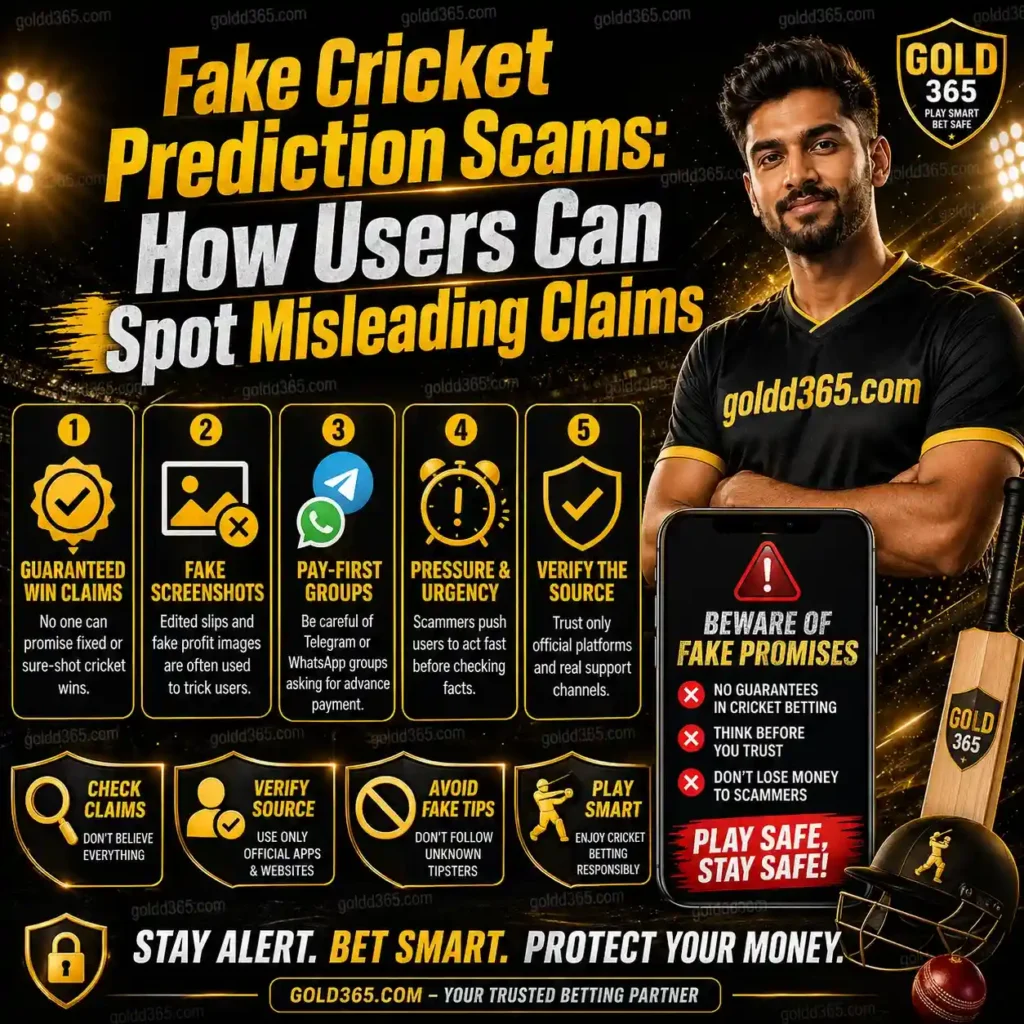
Why Fake Cricket Predictions Become Popular During Big Matches
Cricket prediction scams become more visible during major tournaments because user interest is high. During IPL or international matches, fans are already searching for team news, pitch reports, player form, toss updates, and match analysis. Scammers use that demand to attract attention.
They understand user psychology very well. Many people want quick answers:
- Who will win today?
- Who will win the toss?
- How many runs in the powerplay?
- Which player will score most?
- Which team is fixed?
- Which bet is safe?
Scammers create content that directly targets these questions. They do not need to be accurate. They only need to look confident.
The scam usually works because of three emotions:
| Emotion | How Scammers Use It |
|---|---|
| Greed | They promise easy money or guaranteed profit |
| Fear | They say users will miss the “sure shot” if they wait |
| Hope | They target users trying to recover losses |
When a user is already excited or stressed during a cricket match, they may not think clearly. That is exactly what scammers want.
Nitesh Reddy’s Experience With a Fake Prediction Page
Nitesh Reddy, a regular cricket fan, shared an experience that many users can relate to. He was following IPL updates on social media when he found a cricket prediction page claiming to have “100% accurate toss and match reports.” The page showed several old posts where the predictions looked correct.
At first, Nitesh Reddy thought the account might be genuine because the page had screenshots, comments, and posts showing correct match winners. The page also claimed that their “VIP Telegram group” had insider updates before every match.
Before one IPL match, the page posted a free prediction saying one team would win the toss. After the toss, the prediction appeared correct. This increased Nitesh Reddy’s trust. Later, the page admin messaged him privately and said the next match had a “confirmed report,” but he needed to pay to join the private group.
Nitesh Reddy became suspicious when the admin kept pressuring him to pay before the toss. He checked the page more carefully and noticed something strange. The account had very few comments on old posts, and some posts seemed recently edited. He also found that the same account had posted different predictions in stories earlier, but only the correct one remained visible.
That is when he understood the trick. The page was not predicting correctly. It was deleting wrong predictions and showing only the winning ones.
Nitesh Reddy’s experience shows a common scam pattern: fake success proof, urgency, paid VIP access, and pressure before the user can think clearly.
The “Delete and Edit” Scam Explained
The “delete and edit” scam is one of the most common tricks used by fake cricket prediction pages.

It is also known as survivor bias manipulation.
The scam works like this:
Step 1: Scammer Posts Multiple Predictions
For one match, the scammer creates different posts or videos with different outcomes.
Example:
Post 1: Team A will win
Post 2: Team B will win
Post 3: Toss will be won by Team A
Post 4: Toss will be won by Team B
They may upload these posts on different accounts, private groups, stories, or scheduled posts.
Step 2: The Match Result Comes
Once the real result is known, the scammer checks which prediction was correct.
Step 3: Wrong Predictions Are Deleted
The scammer deletes all incorrect posts and keeps only the correct one.
Step 4: New Users See Only the “Correct” Prediction
A new visitor checks the page and sees a correct prediction. They may think:
“This page predicted the result before the match.”
“They must have real inside information.”
“They have a perfect record.”
But the truth is simple: the wrong predictions were removed.
Step 5: The Scammer Sells Paid Tips
Once trust is created, the scammer promotes the following:
- VIP Telegram group
- Paid WhatsApp tips
- Fixed match report
- Toss prediction package
- Insider cricket news
- Guaranteed recovery plan
- Private betting ID
- Fake betting platform
The scammer is not selling real cricket knowledge. They are selling fake confidence.
Why the Delete and Edit Trick Looks So Convincing
This scam works because people judge what they can see, not what was deleted.
If a page shows ten correct predictions, users may assume the page has ten correct predictions in a row. But they do not see the fifty wrong predictions that were removed.
This is called survivor bias. Only the successful-looking content survives. The failures disappear.
Scammers also make the page look more believable by adding:
- Fake comments
- Edited screenshots
- Luxury lifestyle photos
- Fake payment proofs
- Fake chats with users
- Fake “thank you sir” messages
- Countdown timers
- Limited seat claims
- Fake celebrity images
- Fake news-style graphics
The goal is to create social proof. They want users to feel that many others are already winning.
Common Types of Fake Cricket Prediction Scams
Fake prediction scams appear in many forms. Users should know the most common types.
1. “100% Sure Match Winner” Scam
This is one of the easiest scams to spot.
The scammer claims they know the match winner before the game starts. They may say:
“Today’s match is 100% fixed.”
“Confirm report received.”
“Team A is sure to win.”
“No loss today.”
“Lifetime recovery match”
In real cricket, no one can guarantee a result. Even expert analysts can only estimate probabilities based on form, conditions, team news, pitch, and matchups.
A prediction can be informed. It cannot be guaranteed.
If a page uses “100% sure,” it is a major red flag.
2. Toss Prediction Scam
Toss prediction scams are very common because toss has only two main outcomes. This makes it easy for scammers to fake accuracy.
They may post two different toss predictions in different places and later delete the wrong one.
For example:
Group A sees: Team A will win the toss.
Group B sees the following: Team B will win the toss.
After the toss, the scammer keeps the correct version and shows it as proof.
The toss is random. No real expert can guarantee toss results.
3. Fixed Match Scam
Some scammers claim they have information about fixed matches. This is a serious warning sign.
They may say:
“Today’s match is fixed.”
“Insider report confirmed.”
“Player setting done”
“Bookie report leaked.”
“Only VIP members get fixed matches.”
These claims are usually designed to create urgency and secrecy. They make users feel they are getting hidden information.
In reality, scammers use this language to manipulate users into paying quickly.
Users should avoid any account that claims to sell fixed match information.
4. Session Prediction Scam
In cricket betting, session markets may include runs in a certain number of overs, wickets, boundaries, or player performance.
Scammers may claim:
“Powerplay runs fixed.”
“10 over session confirmed.”
“Next wicket report”
“Death over sure prediction.”
Session outcomes are unpredictable because they depend on bowling changes, batting approach, pitch behavior, field placements, and match situation.
Scammers often use delete-and-edit methods for session predictions too. They post multiple outcomes and keep the correct one.
5. Fake Winning Screenshot Scam
Many fake tipsters show screenshots of large profits.
These screenshots may include:
- Bet slips
- Wallet balances
- Payment receipts
- Bank transfers
- Telegram chats
- User testimonials
- UPI screenshots
But screenshots are easy to edit. A scammer can change numbers, names, dates, and balances using basic editing tools.
A screenshot is not proof of expertise.
Users should be careful when a page uses only screenshots and does not provide transparent, verifiable analysis.
6. Paid Telegram VIP Group Scam
This is one of the most common final goals of fake prediction pages.
The scammer first gives free predictions to build trust. Then they say:
“Join VIP for fixed match.”
“Only paid members get sure tips.”
“Entry closes before toss.”
“Limited seats available”
“Pay now or miss profit.”
After the user pays, several things may happen:
- The admin disappears
- The group gives random tips
- The user is asked to pay more
- The user is moved to another paid level
- The prediction is loses and admin blames user timing
- The group is deleted
Many users do not report these scams because they feel embarrassed or because the payment was made privately.
7. Recovery Scam
Recovery scams target users who have already lost money.
The scammer says:
“Lost money? We will recover today.”
“Guaranteed recovery match.”
“Pay ₹2,000 and recover ₹20,000.”
“Today, single match recovery.”
This is dangerous because it targets emotional users. Someone who has lost money may be more likely to take risks.
Recovery scams often push users into bigger losses. A user may pay for a tip, lose again, and then pay more for another “recovery” chance.
The safest rule is never to chase losses through paid tips.
8. Fake Betting Platform Referral Scam
Some prediction pages are not only selling tips. They are pushing users toward unsafe betting platforms.
They may say:
“Use our official ID.”
“Deposit here for guaranteed profit.”
“Only this platform has a fixed market.”
“Create ID through our agent.”
The user may be asked to deposit money through a private number, unknown website, or unofficial app. This can create payment risk, account risk, and personal data risk.
Users should avoid sharing ID proof, bank details, OTP, or payment screenshots with unknown tipsters.
Warning Signs of Fake Cricket Prediction Pages
Users can spot many scams by watching for red flags.
| Warning Sign | Why It Is Risky |
|---|---|
| “100% sure” claims | No one can guarantee cricket results |
| “Fixed match” language | Often used to create fake insider trust |
| Payment before toss | Pressure tactic |
| Deleted posts | May hide failed predictions |
| Edited screenshots | Easy to fake |
| Fake luxury lifestyle | Used to create false success image |
| No clear analysis | Only emotional claims |
| VIP group pressure | Common scam funnel |
| Urgency countdown | Stops users from thinking |
| No refund policy | Payment risk |
| Requests for OTP or password | Account theft risk |
| Random APK links | Fake app or malware risk |
If a page shows more than one warning sign, users should avoid it.
How Scammers Use Pressure Tactics
Pressure is a key part of prediction scams.
Scammers know that if users take time to think, they may notice the fraud. So they create urgency.
Common pressure lines include:
- “Pay before toss.”
- “Only 5 seats left.”
- “Entry closing in 10 minutes.”
- “Last chance for a sure match.”
- “Don’t miss today’s fixed report.”
- “After the toss, the price will double.”
These messages are designed to stop critical thinking. They make users act emotionally instead of logically.
A genuine analyst does not need to pressure users. A scammer does.
Why “Inside Information” Claims Are Dangerous
Fake tipsters often claim they have inside information. They may say they know team plans, player performance, toss results, or match-fixing details.
Users should be careful with these claims for two reasons.
First, most such claims are fake. They are used to sell paid access.
Second, even if someone claims to have illegal or insider information, engaging with that can create serious risk. Users should avoid anything that sounds like match fixing, manipulation, or illegal inside access.
A trustworthy cricket analyst discusses public information such as the following:
- Team form
- Pitch report
- Weather
- Player availability
- Head-to-head record
- Batting order
- Bowling matchups
- Venue history
They do not sell “secret fixed reports.”
How Users Can Verify Cricket Information Safely
Users should rely on official and trusted sources for match information.
Helpful sources include:
- Official cricket boards
- Official IPL updates
- Team announcements
- Verified sports journalists
- Known cricket analysis platforms
- Live score platforms
- Official broadcaster updates
Users should cross-check major claims instead of trusting one random social media page.
- If a page says a player is injured, check official team news.
- If a page says Toss is fixed, ignore it.
- If a page says match winner is guaranteed, treat it as a scam.
- If a page says they have secret news, ask why they are selling it in DMs.
Real information can usually be verified. Fake insider claims usually cannot.
How Users Get Trapped Step by Step
Most users do not get scammed all at once. The scam usually happens in stages.

Stage 1: Discovery
The user sees a prediction page through Instagram, YouTube, Telegram, WhatsApp, or search.
Stage 2: Trust Building
The page shows old correct predictions, fake screenshots, and user testimonials.
Stage 3: Free Prediction
The scammer gives one or two free tips. They may use delete-and-edit tricks to make them look accurate.
Stage 4: Private Message
The admin contacts the user or asks them to join a private group.
Stage 5: Payment Pressure
The user is told to pay quickly before the toss or match starts.
Stage 6: Loss or Further Payment
If the tip fails, the scammer may blame timing, changing odds, or user mistake. Then they offer another paid recovery tip.
Stage 7: Block or Disappear
If the user complains, the scammer may block them, delete chats, or change the account name.
Understanding this pattern helps users stop before payment.
What Users Should Do If They See a Fake Prediction Scam
If users encounter a suspicious cricket prediction page, they should take these steps.
1. Do Not Pay
Never transfer money for guaranteed match tips, toss predictions, fixed reports, or VIP insider groups.
2. Do Not Share Personal Information
Do not share:
- Phone number
- OTP
- Password
- Bank details
- UPI ID screenshots
- ID proof
- Betting account login
- Payment app screenshots
3. Check the Page History
Look for deleted content, low-quality comments, sudden success claims, fake engagement, and edited captions.
4. Report the Account
Use the report option on Instagram, YouTube, Telegram, WhatsApp, or other platforms.
5. Warn Friends and Family
If someone you know is following such pages, please explain the delete-and-edit scam.
6. Avoid Unknown Links
Do not click random betting links, APK downloads, or “backup login” pages shared by tipsters.
7. Keep Evidence
If money was lost, save screenshots of chats, payment proof, account details, and group links before the scammer deletes them.
What to Do If You Already Paid a Fake Tipster
If a user has already paid money to a fake prediction page, they should act quickly.
Steps to take:
| Step | Action |
|---|---|
| Stop paying more | Do not pay for recovery or refund charges |
| Save proof | Keep screenshots and transaction records |
| Block further contact | Avoid more manipulation |
| Report the account | Use platform reporting tools |
| Contact payment provider | Check if dispute or complaint option exists |
| Warn others | Help prevent more victims |
| Secure accounts | Change passwords if details were shared |
Scammers may ask for more money to “recover loss” or “release VIP refund.” That is usually another scam.
Do not send more money.
How to Judge a Real Cricket Analyst vs Fake Tipster
Not every cricket prediction page is a scam. Some people share genuine analysis. But users should know the difference between analysis and guarantee.
| Real Analyst | Fake Tipster |
|---|---|
| Talks about probability | Says 100% sure |
| Explains reasoning | Uses pressure and hype |
| Accepts uncertainty | Claims fixed result |
| Uses public data | Claims secret insider |
| Does not force payment | Demands urgent payment |
| Shows balanced views | Shows only winning screenshots |
| Warns about risk | Promises easy money |
A real analyst may be wrong because cricket is uncertain. A fake tipster pretends they cannot be wrong.
Why Easy Money Claims Are Dangerous
The phrase “easy money” is one of the biggest warning signs.
Betting is risky. Cricket is unpredictable. No one can remove uncertainty from a live match. If someone says they can guarantee profit, they are selling false confidence.
Easy money claims can push users into the following:
Overbetting
Borrowing money
Chasing losses
Joining unsafe groups
Sharing private details
Depositing on fake platforms
Trusting edited proof
The safest mindset is as follows: if a claim sounds too easy, it is probably designed to trap you.
Responsible Betting and User Protection
Users should remember that betting is never a guaranteed income source. Prediction scams become more dangerous when users are already emotionally involved.
Users should avoid betting when:
- They are trying to recover losses
- They are using borrowed money
- They are under pressure from tipsters
- They do not understand the market
- They are angry or stressed
- They are below the legal age
- Betting is not legal in their location
- They feel unable to stop
Healthy decision-making matters more than any prediction.
A user should never allow a Telegram admin, Instagram page, or fake “expert” to control their money decisions.
Safety Checklist for Users
Before trusting any cricket prediction page, users should ask:
| Question | Safe Answer |
|---|---|
| Does the page say 100% sure? | If yes, avoid |
| Does it claim a fixed match? | If yes, avoid |
| Does it ask for urgent payment? | If yes, be careful |
| Are old posts deleted or edited? | Red flag |
| Are screenshots the only proof? | Not reliable |
| Does it explain analysis clearly? | Better sign |
| Does it admit risk? | Better sign |
| Does it ask for OTP or password? | Scam risk |
| Does it promote unknown betting links? | Scam risk |
| Can claims be verified from official sources? | Important |
This checklist helps users avoid emotional decisions.
FAQs About Fake Predictions
What is a fake cricket prediction scam?
A fake cricket prediction scam is when a person or page claims to provide guaranteed cricket results, toss predictions, fixed match tips, or insider reports to make users pay money or join unsafe groups.
What is the delete and edit scam?
The delete and edit scam is when scammers post multiple predictions, delete the wrong ones after the match, and keep only the correct prediction visible. This creates a fake record of accuracy.
Can anyone predict cricket matches with 100% accuracy?
No. Cricket is unpredictable. No one can guarantee a toss, wicket, session score, or match result with 100% accuracy.
Are paid Telegram cricket tips safe?
Many paid Telegram tip groups are risky because they use fake proof, pressure tactics, and edited screenshots. Users should be very careful and avoid paying for guaranteed tips.
How do fake tipsters create fake proof?
Fake tipsters create fake proof by deleting wrong predictions, editing screenshots, using fake chats, showing fake payment receipts, and posting only successful-looking results.
What should I do if someone asks for money for fixed match tips?
Do not pay. Fixed match claims are a major scam warning. Report the account and avoid sharing personal or payment details.
How can users spot misleading cricket prediction claims?
Users can spot misleading claims by watching for words like “100% sure,” “guaranteed,” “fixed,” “VIP insider,” “pay before toss,” and “recover losses today.”
What should I do if I already paid a fake prediction page?
Stop paying more, save screenshots, report the account, contact your payment provider if possible, secure your accounts, and warn others.